
Data warehousing enables enterprise wide data to be centralized in a structured repository optimized for analytics and allows organizations to query data quickly. This provides consistent reporting and enable organizations to use business intelligence platforms to support integrated decision making processes using robust data governance frameworks.
Table of Contents
- Understanding the Data Warehousing Concepts
- How to Implement a Data Warehouse Successfully
- Importance of Data Warehousing for Business Analytics
- Key Benefits of Data Warehousing for Organizations
- How Data Warehouses Work Across Industries
- Data Warehousing Best Practices for Scalable Implementations
- Data Warehouse Tools and Modern Platform Options
- Data warehouse vs. data lake
- Conclusion
Large amounts of data are generated across separate, non-integrated operational systems that make it difficult to analyze this data within an organization. The centralization of this data through data warehousing provides the structure and repository needed for analytical processes.
Data warehouses are expected to grow to $69.64 billion by 2029, based on organizations’ focus on centrally managed data solutions.
Transaction and analysis activities are separated in a data warehouse, allowing for a single point of truth for organizational data. Companies that have implemented successful, scalable data warehouse solutions will achieve improvements in their analytical query execution time and implement high level business intelligence functions to support strategic decisions.
Understanding the Data Warehousing Concepts
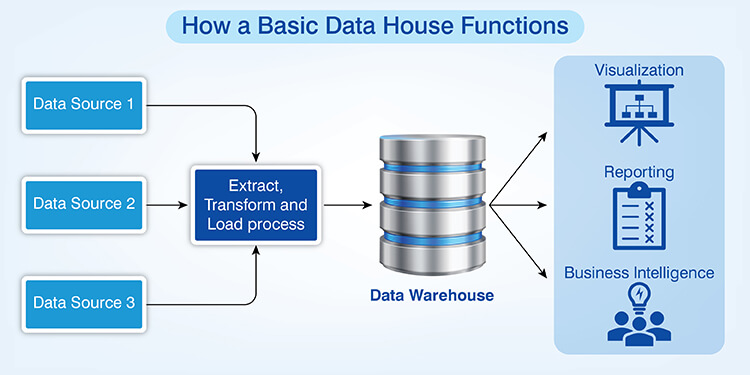
A data warehouse is a central storehouse of data in an integrated form (from one or more operational systems) to be used for analytical queries and for use in business intelligence applications. An understanding of data warehousing definitions can help in knowing how data warehouses differ from traditional transactional databases.
The core goals of data warehouses are to bring together data from multiple sources, maintain a history of all data and provide a stable environment for analytical processes to take place.
The key attributes of well-designed data warehouses are subject-oriented, where data is organized by business subject, integrated data with consistent nomenclature, time-variant historical data to enable trending analysis and non-volatile data storage for analytical purposes, which allows the data to remain unchanged over time.
Data warehousing today is the analytical foundation for business intelligence platforms and the support system for data driven decision making in organizations.
Build a scalable data warehouse that powers faster decisions
Build my warehouseHow to Implement a Data Warehouse Successfully
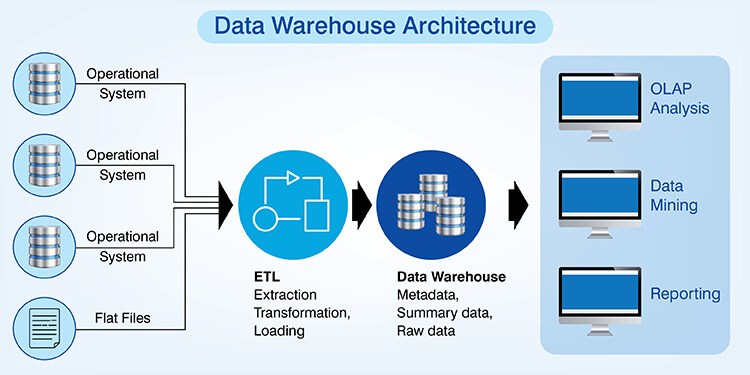
To implement a data warehouse, you need to develop a set of methodologies that will ensure alignment of technical architecture and business objectives.
Step 1. Define your business objectives and analytics requirements: Define which business problems are specifically being addressed and what KPI’s, reports, etc. are needed in order to make decisions, with input from all stakeholders.
Step 2. Identify and evaluate your data sources: Create a list of all operational databases, enterprise applications and other third party systems. Identify the level of quality and reliability of each of these data sources. The complexity of this step will increase with the rising number of data sources as many experts predict that 75% of enterprise data will be created and processed at the edge by 2025.
Step 3. Design the data warehouse architecture: Choose the appropriate hardware and software technologies based upon the types and quantities of workloads that will be placed upon them. Select either on-premise or cloud data warehousing tools based upon the constraints of your organization.
Step 4. Build ETL (Extract, Transform, Load) or ELT (Extract, Load, Transform) pipelines: Build ETL and ELT pipelines to perform extraction, transformation and loading of data. Implement transformation logic to ensure data integration and normalization into a consistent format prior to loading into the data warehouse.
Step 5. Create structured data storage and data models: Use dimensional modeling to design the structural schemas (fact and dimension tables) and implement structured data storage to support analytical query optimization.
Step 6. Enable analytics, business intelligence and controlled data access: Integrate with your business intelligence platforms to provide reporting and visualizations and establish role based access controls to limit access to sensitive data.
Step 7. Test, optimize, and deploy at scale: Conduct comprehensive testing including validation and performance benchmarking and optimize queries and indexes before deploying the solution at scale.
Step 8. Monitor, govern, and evolve the data warehouse: Establish a framework for ongoing data governance to maintain quality and security of the data within the data warehouse. Continuously monitor and plan for incremental improvements to the data warehouse solution.
Importance of Data Warehousing for Business Analytics
Data warehouse architecture is essential to achieve a competitive advantage through the ability to support and enable advanced analytics capabilities within an enterprise.
Separating transactional and analytical workloads are significant architectural principles. Operational systems do not perform well with complex analytical queries. Data warehouses create separate environments for analytics without affecting operational performance.
Unified information standards are required to be able to consistently report using common metrics across teams. Departments querying separate systems create conflicting reports. The financial impacts of poor data quality can have a severe cost to an enterprise. Surveys show poor data costs an enterprise approximately $15 million per year.
A data warehouse supports business intelligence platforms by providing a robust infrastructure to support these applications. Modern business intelligence tools are designed to operate against optimized structures and provide fast query response times. Building scalable analytics infrastructure requires purpose built solutions that provide stable foundations for increasingly sophisticated workloads.
Key Benefits of Data Warehousing for Organizations
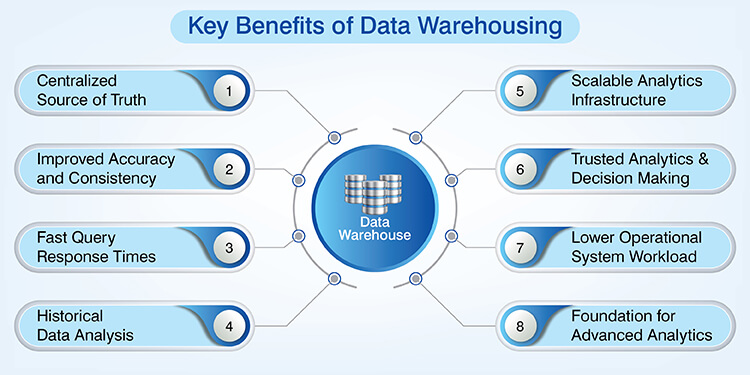
When organizations implement an effective solution they experience substantial advantages in the form of key data warehouse benefits:
- A centralized source of truth eliminates confusion caused by multiple data sources and reduces the time it takes to reconcile and increases confidence.
- The improved data accuracy and consistency is due to the standardization of data integration and normalization processes using uniform transformation rules and business logic.
- Fast response times for analytical queries are achieved through optimized structural design for storing data in column format and dimensionally. This allows for the quick execution of complex, multi-dimensional queries.
- The ability to analyze historical data allows for the preservation of extended time frames allowing for comparative analysis and trend identification to inform strategic planning.
- Supports growing volume and scalable analytics infrastructure enables businesses to grow while providing analytics capabilities. Most modern cloud data warehousing tools provide elastic scalability allowing resource allocation to be automatic.
- Trusted analytics enables better decision making where decisions are made rapidly based on factual evidence. This strategic advantage often translates into a very high return on investment, typically over three years, producing a 127% return on investment.
- Lowers the operational system workload by removing analytical queries from operational systems and moving them to a dedicated analytic infrastructure. Studies have shown that migrating these workloads to the cloud potentially reduces total operational costs up to 51%.
- Provides a solid foundation for advanced analytics. This positions organizations for future machine learning and artificial intelligence applications that require clean, consistent data.
Data Warehouse Services Empower Advanced Analytics for Manufacturer

A leading provider of an IoT platform had issues in performing predictive analytics due to the limitations on the amount of data available through their APIs. They had no formal process documenting the migrations of their data and they were unable to grant sufficient access to their operational datasets to allow users to create reports as well as perform advanced analysis.
Hitech Analytics developed a cloud based AWS Redshift data warehouse utilizing automated ETL pipelines for the ingestion of IoT data in real time and for migrating historical data into the data warehouse. This helped provide the customer with a single repository of data that could be accessed by multiple groups within the organization through secure role-based access for both reporting and analytics purposes.
The end results were:
- A cloud-based data warehouse capable of providing 24×7 uptime.
- Scalable storage for real-time and historical analytics
- Ability to perform custom reporting and advanced insights
Design cloud-ready data warehouses that grow with your business
Go cloud-readyHow Data Warehouses Work Across Industries
When you have a good idea of data warehouse use cases, you will know where they can provide the most benefit to your organization.
- Enterprise reporting and KPI dashboards
Data is consolidated from operations and enables executive management to view overall organizational performance using standardized measurements, without changing or affecting the transactional systemsa
- Sales, marketing & customer analytics
The integration of direct sales enables organizations to utilize the real time information from their customers and inventory levels to enable omnichannel strategies and as an example, 25.8% higher conversion rates for retailers.
Teams are able to evaluate the effectiveness of campaigns and analyze customer segmentation by combining CRM systems, web analytics and transaction databases to develop an overall understanding of the customer.
- Financial analysis and regulatory reporting
Finance departments consolidate accounting systems and operational databases that produce accurate financial statements and regulatory reports with audit trails as required by regulations.
- Operational performance and strategic planning
Organizations are able to measure the efficiencies of each process and access historical trends to enable the development of predictive models and long term forecasting that inform strategic decision making.
Data Warehousing Best Practices for Scalable Implementations
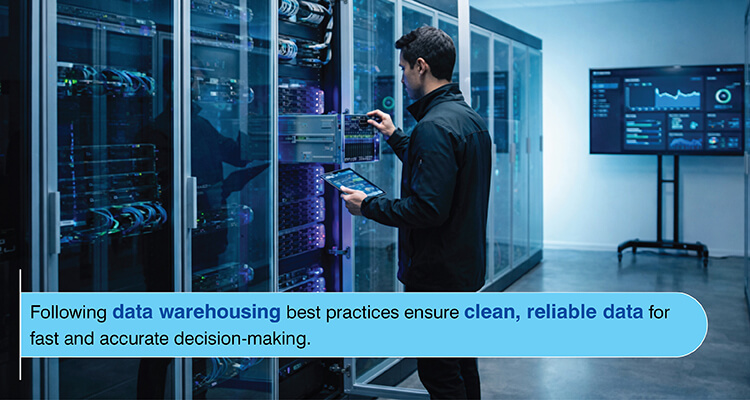
Following data warehousing best practices help ensure that implementations provide expected business value as follows:
- Design implementation that is aligned with business goals with continuous stakeholder engagement (validate technical decisions will meet all requirements).
- Use data models that are optimized for analytics by using a dimensional model with fact tables & dimension tables that improve query performance.
- Create robust automated ETL and ELT pipelines that allow reliable integration with comprehensive error handling and quality validation. This is trending towards real time with over 60% of organizations moving to streaming ETL to receive Instant Insights.
- Standardize data integration and normalization by establishing clear transformation standards and business rules that are applied uniformly across all sources.
- Optimize performance and cost proactively by Implementing appropriate partitioning, indexing and aggregation based on actual usage patterns.
- Enforce data governance and security controls by protecting sensitive information with role based access and audit logging.
- Design implementation to be incrementally scalable with modular architecture that allows new sources and capabilities to be added without re-designing entire implementation.
- Continuously monitor and improve by tracking performance metrics and utilization to guide ongoing optimization.
Data Warehouse Tools and Modern Platform Options
Selecting appropriate data warehouse tools affects implementation success, costs and scalability. The following table compares the top tools in detail on the basis of selected parameters:
| Criteria | Snowflake | Google BigQuery | Amazon Redshift | Azure Synapse | Teradata |
|---|---|---|---|---|---|
| Deployment model | Multi-cloud architecture | Google Cloud native | AWS native | Azure native | Hybrid deployments |
| Scalability | Automatic elastic scaling | Serverless auto-scaling | Manual cluster resizing | Elastic pools | Manual scaling |
| Query performance | Optimized mixed workloads | Strong large scan performance | Parallel processing with tuning | Distributed query engine | Advanced query processing |
| Data ingestion | Snowpipe continuous loading | Streaming and batch ingestion | AWS pipeline integration | Azure Data Factory native | Comprehensive ETL tooling |
| Cost structure | Separate compute/storage pricing | Pay-per-query model | Reserved or on-demand | Consumption-based pricing | Subscription models |
| BI integration | Broad compatibility | Google Data Studio native | Major BI tool support | Power BI native integration | Extensive platform support |
| Security | Enterprise encryption | Google Cloud framework | AWS security integration | Azure Security Center | Advanced governance |
| Maintenance | Minimal administration | Fully managed | Cluster management required | Managed with configuration | Higher complexity |
Data warehouse vs. data lake
Understanding differences of data warehouse vs. data lake help organizations determine what architecture is best suited for their needs. A data warehouse stores structured and processed data optimized for analytical query purposes. The structure of the data within a data warehouse is defined by an enforced schema, and this processing occurs prior to storing the data.
A data lake, on the other hand, is designed to store data in its native format with no pre-defined schema prior to storage. Because of that design, a data lake can handle data in three different types: structured, semi-structured, and unstructured. The process of defining the schema for data stored in a data lake occurs after it has been loaded into the data lake.
Because data lakes are capable of handling so many different types of data, they are often used as a data landing zone to collect various types of data. Data warehouses, however, provide structured and governed environments for the organization to report out on business critical issues.
Conclusion
Although data warehousing has changed in terms of how it is deployed, it remains a key component in enterprise analytics and will continue to be so in the future. Organizations that develop robust data warehousing solutions with strong data governance, well-tuned ETL/ELT data movement processes and best in class data warehouse tools will have a competitive advantage due to their ability to perform better analytical tasks.
Cloud data warehousing tools and real-time data access make high level analytics possible with much less investment in large scale IT infrastructures. A well designed data warehouse provides a foundation for ongoing analytical excellence and long term business success.
Structure your data for BI, dashboards, and decision-making
Contact us
At Hitech Analytics, we understand that each company has different needs, business goals and technology environments. With advanced analytics, you can make right decisions, prepare for the future and leverage intelligence from huge data volumes. We embed analytical intelligence into your everyday data and turn it into actionable insights.