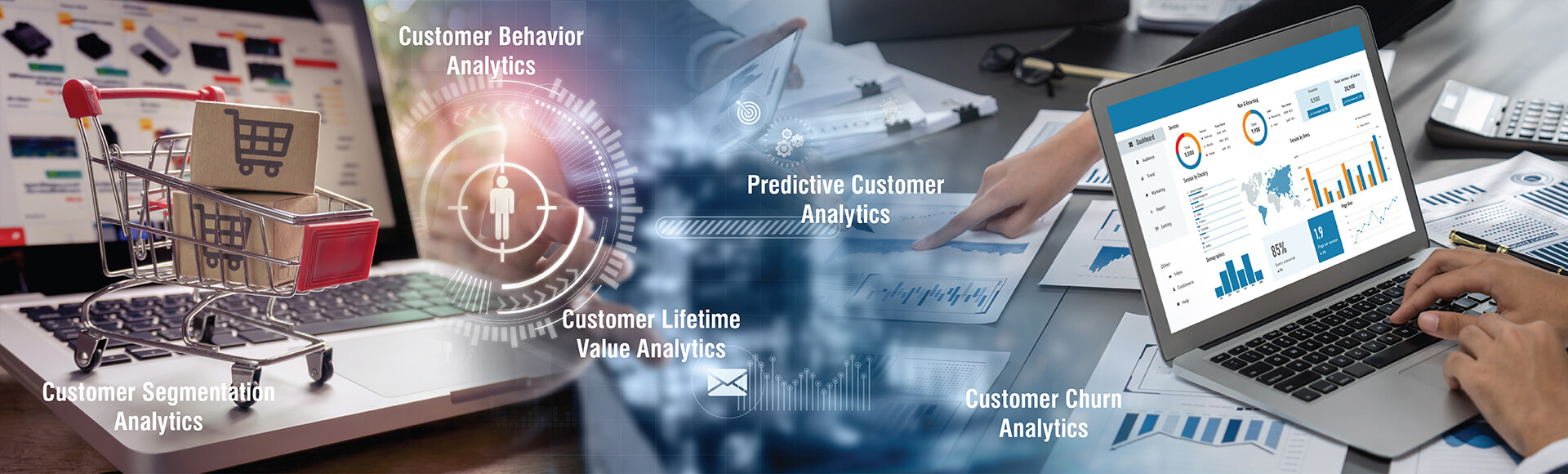
Customer analytics for ecommerce comprises five essential forms. Behavioral analysis identifies customer purchasing behavior, segmentation allows you to target specific areas of growth, predictive analytics helps anticipate future customer behaviors; lifetime value helps guide the profitability of your business decisions; and churn analytics helps prevent customer loss.
Table of Contents
E-commerce companies often struggle with higher costs of acquisition, lower conversion rates and increased churn despite having a wealth of transaction data to work from. Competition for consumers’ time and money gets intense as 21% of all retail sales were made online in 2025.
Traditional analytical techniques cannot provide the reason behind customers leaving their shopping carts empty or why they stop engaging with your company after they make a purchase.
Customer analysis services are designed to fill that void, by converting transactional and behavioral information into valuable business intelligence. This enables companies to better understand the intent and to deliver personalized experiences to their customers on a large scale.
A framework for structured customer analytics ecommerce can help companies to optimize the way they spend money, to minimize attrition and to increase lifetime profitability. Studies show that companies that use data to drive decision making, are 23 times more likely to gain new customers and 19 times more likely to have profits than companies that rely solely on instincts.
In this article we will discuss the five different types of customer analytics which are the core components of a successful customer intelligence system.
Understanding customer analytics in ecommerce
Customer analytics for ecommerce is the organized gathering and evaluation of how customers behave, their preferences and engagement with all aspects of the brand’s digital presence.
The key difference between customer analytics and other forms of analytics is that customer behavior analysis allows you to look at the individual motivations of the customer and what drives those.
The primary strategic value of customer analysis services is achieved when multiple types of analytics are used in combination to create an integrated view of each customer.
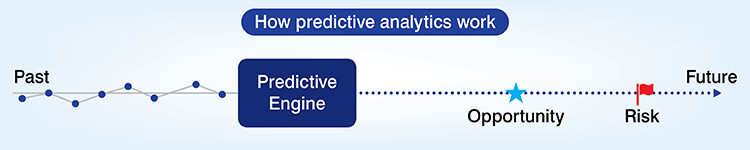
Behavioral analytics analyzes what customers have done, segmenting analytics helps identify similar customers, predictive analytics identifies future behaviors, lifetime value analytics provides insight into the potential profit of each customer and churn analytics helps detect customers who are at risk of leaving the business.
Discover high-value customer segments hidden in your data
Uncover customer segments5 essential types of customer analytics
These major customer analytics types focus on addressing different problems and used to support an integrated view of the customer to help form data based ecommerce strategies for development.
A. Customer behavioral analytics for understanding buyer actions
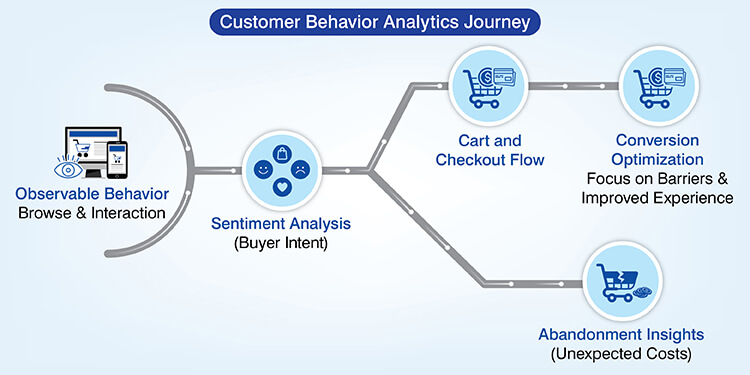
Customer behavior analysis in ecommerce is the study of all the behaviors that occur during each shopping experience. Therefore, it is the base of essential customer analytics for online stores and provides insight into shopper’s intent through observable behavior.
Behavioral analytics include how customers browse products, which products they interact with, their sentiment analysis, what they place in their shopping carts and checkouts and which products they do not purchase.
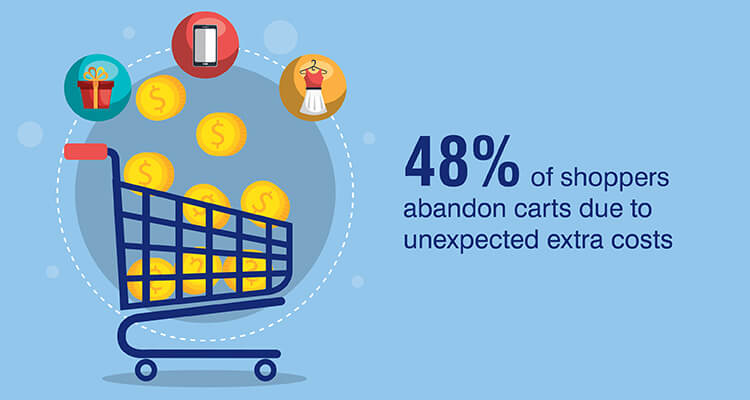
If a customer consistently abandons after seeing shipping costs, then this indicates very clear areas of opportunity for improvement. In fact, 48% of shoppers abandon a purchase because of additional charges that were not expected. Therefore, behavioral data from customer intent analysis services could provide direction for a retailer to present pricing information in a way as to reduce this.
Using behavioral indicators allow for greater accuracy in conversion rate optimization by focusing on the specific barriers to conversion and also allows for improved customer experience metrics.
Real Time Sentiment Analysis for a USA Based Sports Data Company

A Las Vegas based multiline data aggregator was tasked by a sports client to create a proof of concept to extract real time sentiment from their client’s NBA, NFL, baseball, college football and basketball social media content postings. The multiline data aggregator faced issues with large volumes of unstructured data and extracting sentiment.
Hitech Analytics created a real time sentiment analysis system using NLP and AI/ML to take in streaming social media text, determine polarity from -1 to +1 and display strategic decision making insights on user friendly dashboards.
The end results were:
- 100% real time access to public opinion on preference
- 85% savings on manual survey costs
- 97% accuracy in social media sentiment analysis
B. Customer segmentation analytics for targeted growth
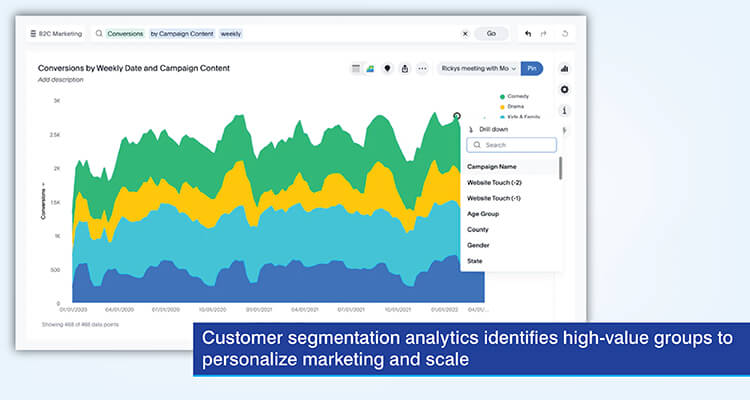
Customer segment analysis is an opportunity for e-commerce organizations to determine how many distinct types of customers exist, who they are, what their respective needs are and which type of customers generate the most revenue.
Following are the types of customer segmentation models and how they help in scaling personalization strategies in ecommerce:
- Behavioral segmentation: Customers divided into categories based on their observable actions, i.e., browsers vs. buyers, price sensitive vs. non price sensitive, category focused vs. variety seeking, etc.
- RFM based: Customers classified according to their recency, frequency and monetary value to differentiate between active, inactive and newly acquired customers. This necessitates varying degrees of effort to engage them.
- Lifecycle segmentation: Customers tracked from the time of acquisition through the stages of growth, maturity and decline, each with specific engagement strategies. This includes onboarding for new customers, cross selling for growing customers and reactivation for customers in decline.
- Engagement based segments: Active or passive customers, content consumers or transaction focused buyers are determined by level of engagement and communication strategy appropriate to each group.
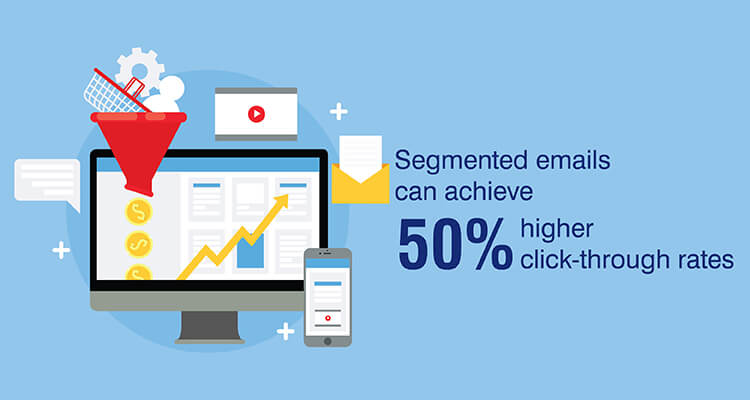
- Campaign relevance: Higher engagement rates will result when messaging aligns with segment characteristics, preferences and proven needs via all channels. E-mails segmented by customer segments has shown open rates of 30% and click through rates of 50% compared to generic blasts.
- Marketing efficiency: Resources are optimized across customer groups as a function of demonstrated value and projected lifetime value.
- Strategic differentiation: Correct investment levels made for high value vs. low value customer segments as a means to avoid excessive spending on unprofitable relationships.
Data integration from customer analysis services ensure that the definition of each customer segment remains relevant as their behaviors change and each segment’s membership changes during each customer lifecycle.
C. Predictive customer analytics for anticipating behavior
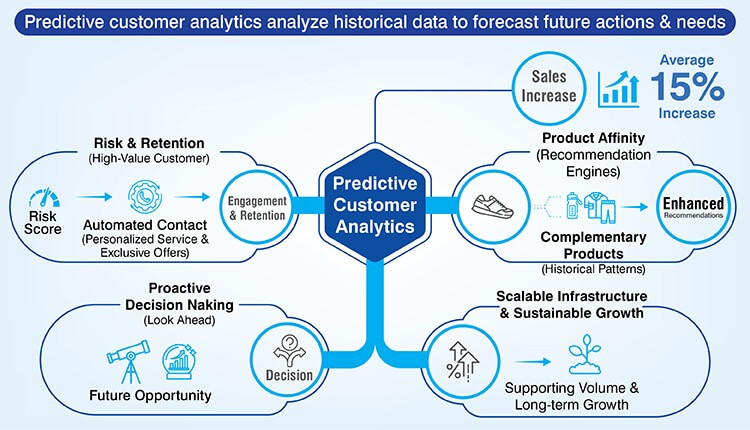
Ecommerce predictive analytics provides a window into what consumers may do next, allowing them to identify opportunities to respond to needs prior to a critical moment in the transaction cycle.
Companies that utilize predictive analytics see positive results. According to research, organizations employing predictive analytics experience on average a 15% increase in sales.
Predictive analytics for customers also generates risk scores which trigger automated contact with the high value customer. The high value customer showing decreased engagement will be contacted by the retailer with personalized service or exclusive retention offers that are tailored to the customer’s risk profile.
Prediction helps in product affinity by enabling retailers to create recommendation engines. The retailer will send the customer who has purchased running shoes recommendations for other products that are complementary to the running shoe, i.e., athletic wear or fitness accessories, based upon historical purchasing patterns of other customers that have made similar purchases.
Benefits to the business include making decisions from a position of being able to look ahead at a potential opportunity vs. having to react to it once it occurs. Retailer operations can scale its supporting infrastructure to meet the expected volume of traffic and provide support for sustainable long term growth.
D. Customer lifetime value analytics for profitability decisions
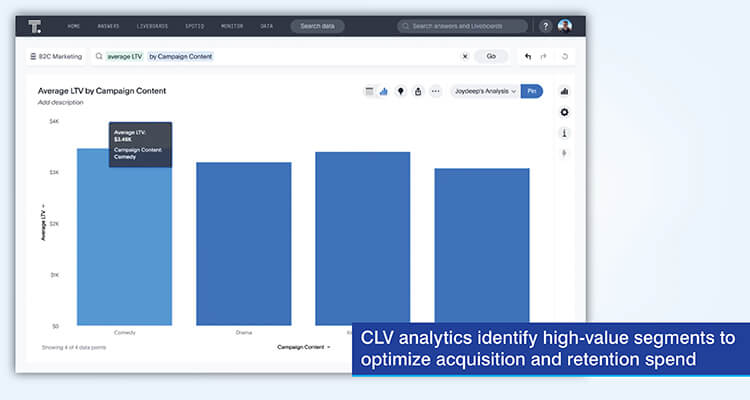
The customer lifetime value analysis measures the total economic value that individual customers create during their entire customer relationship. It creates the financial base for customer centered decision making focusing long term profitability rather than short term revenue.
CLV represents the net present value of all profit contributions that an individual customer will make over his/her relationship with your organization, which includes acquisition costs, service costs and the estimated relationship duration.
CLV application
Acquisition alignment
- Analytical focus: Customer LTV vs CAC by channel
- Decision impact: Identify profitable acquisition sources
- Business outcome: Optimized marketing spend allocation
- Implementation example: Email campaigns generating $500 LTV customers justify $150 CAC while social ads with $200 LTV customers require <$75 CAC
CLV application
Retention priority
- Analytical focus: Segment level lifetime value
- Decision impact: Allocate retention budgets proportionally
- Business outcome: Maximized retention ROI
- Implementation example: High value segments ($2000+ LTV) receive dedicated account managers while lower segments get automated engagement
CLV application
Channel evaluation
- Analytical focus: Long term value vs immediate conversions
- Decision impact: Assess true channel performance
- Business outcome: Improved marketing ROI
- Implementation example: Organic search generates lower initial conversions but higher retention rates yielding superior lifetime economics
CLV application
Product strategy
- Analytical focus: Product level customer profitability
- Decision impact: Prioritize product development
- Business outcome: Enhanced product portfolio
- Implementation example: Products attracting high LTV customers receive expanded inventory and feature investment
As there is a 60-70% chance of successfully selling to an existing customer compared to a 5-20% chance of successfully selling to a new customer, use of a CLV analysis is critical in order to prioritize high yielding customer relationships.
Build precise customer profiles to improve targeting accuracy
Build profilesE. Customer churn analytics for preventing customer attrition
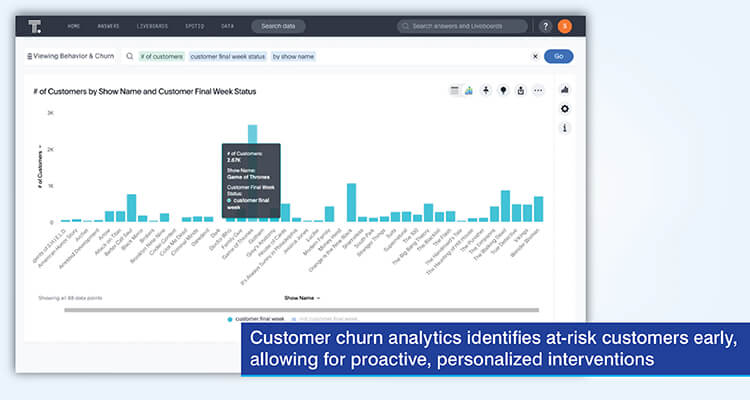
The purpose of customer churn analysis is to understand and reduce the rate of attrition through the identification of attributes that result in a customer ending their relationship with your company.
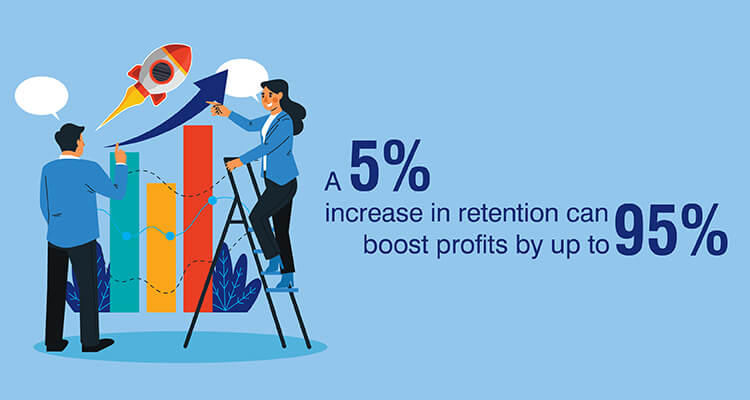
Retaining your current customer base will cost you less money than obtaining a new one. There is substantial financial upside. A 5% increase in customer retention can potentially create a 25% to 95% profit increase for your company.
Churn analysis examines customer retention trends, customer engagement decline and inactivity. Early warning indicators of potential customer disengagement are mainly the following:
- A reduction in the frequency of purchases compared to previous purchase history.
- A decrease in the number of times a customer visits your web site or uses your application for consecutive time periods.
- A reduction in email open and click rates.
For example, if an individual has historically made a monthly purchase but now has been inactive for eight weeks, this would trigger multiple risk flags. The ability to track these activities systematically provides the opportunity to identify customers who may be at risk of disengaging and allows for timely intervention.
Segment level analysis recognizes that the characteristics that drive customer churn differ between customer segments. For example, new customers have different challenges than long term customers. Combining eCommerce data insights from customer service interactions and reviews with other data sources provides additional predictive capability beyond just behavioral data.
Retention and loyalty analytics provide guidance for developing targeted interventions based upon the unique risks associated with each customer segment. For example, price sensitive customers may be sent promotional offers while service issue customers may be proactively contacted by a member of the service team.
Operationalizing customer analytics across ecommerce teams
Transforming insight to impact necessitates the consistent incorporation of customer analytic tools into the workflows and decision making processes of an e-commerce team. The need to do this is crucial because according to recent reports 68% of enterprise data does not get used and therefore does not contribute to any form of decision making.
Role of customer analysis services in execution
Customer analysis services transform outputs into actionable insights by converting technical results into a form of business communication. Customer data is integrated across multiple platforms, thereby removing the silos that create fragmented views of the customer. Instead of reporting on a batch basis at intervals, decision ready reporting creates streams of intelligence in real time.
Aligning analytics with ecommerce functions
Analytics can be leveraged by marketing to optimize acquisition activities via behaviorally derived segmentation and insights. When marketing is properly aligned with such insights, research has demonstrated that marketing revenue can increase up to 208%.
Conversion rate optimization gains precision via a detailed funnel based understanding. Product teams leverage insights for product experience enhancements using friction point analyses. Customer experience teams utilize churn analytics to optimize retention activities.
Avoiding common analytics execution challenges
Typical challenges include viewing analytics as a form of reporting versus decision Support. Siloed insights are created when separate departmental teams develop their own independent analytics capabilities without coordination between them. Effective operations establish clear ownership linking insight to actionable decisions.
Business value of analytics driven operations
A higher return on investment (ROI) from customer analytics e-commerce investments are realized when Insights consistently inform decisions rather than solely serve as monitoring functions.
Conclusion
These five essential customer analytics for online stores provide a cohesive system of analysis that can be used to understand consumer behavior, predict future actions and ultimately optimize their consumer experience.
When survey shows data such as 76% consumer dissatisfied with the fact that websites do not have personalized features on them, customer analytics become a necessity for survival for many online businesses.
Competitive advantage is earned by those companies who are able to effectively translate their analytical capability into action by integrating the analytical function across all business disciplines through a well defined and structured process.
Strengthen brand loyalty by analyzing to customer sentiment
Contact us
At Hitech Analytics, we understand that each company has different needs, business goals and technology environments. With advanced analytics, you can make right decisions, prepare for the future and leverage intelligence from huge data volumes. We embed analytical intelligence into your everyday data and turn it into actionable insights.